



From Perspemtive February 22, 2026 at 9:50 AM
Despite ongoing negotiations, massive troop movements point to concrete preparations for war against Iran. The US is building its largest military presence in West Asia since the 2003 invasion of Iraq. Meanwhile, the right-wing factions of the Iranian opposition in exile are being courted by the West and are pushing for an attack. – A commentary by Sohrab Mobasheri.
An advisor to US President Donald Trump estimates a “90 percent probability” of a US military strike against Iran in the coming weeks. While the negotiations between Iran and the US held in Geneva on February 17th concluded with the announcement of further talks, the 12-day war waged jointly by Israel and the US against the Islamic Republic of Iran in June 2025 demonstrated that the US can also use negotiations as a mere pretext for war preparations.
The then-surprising attack by Israel on the Islamic Republic , conceived as a decapitation strike and coordinated with US President Trump, occurred between two rounds of Iranian-American negotiations – more precisely, just two days before the scheduled meeting on June 15, 2025, which the government in Tehran cancelled due to the war.
Bob Harward, former deputy commander of the US Central Command (CENTCOM) and former vice admiral, also expects the US to launch another military strike against Iran, just eight months after Operation Midnight Hammer. This would unleash a massive wave of destruction against Iranian military structures, according to Harward.
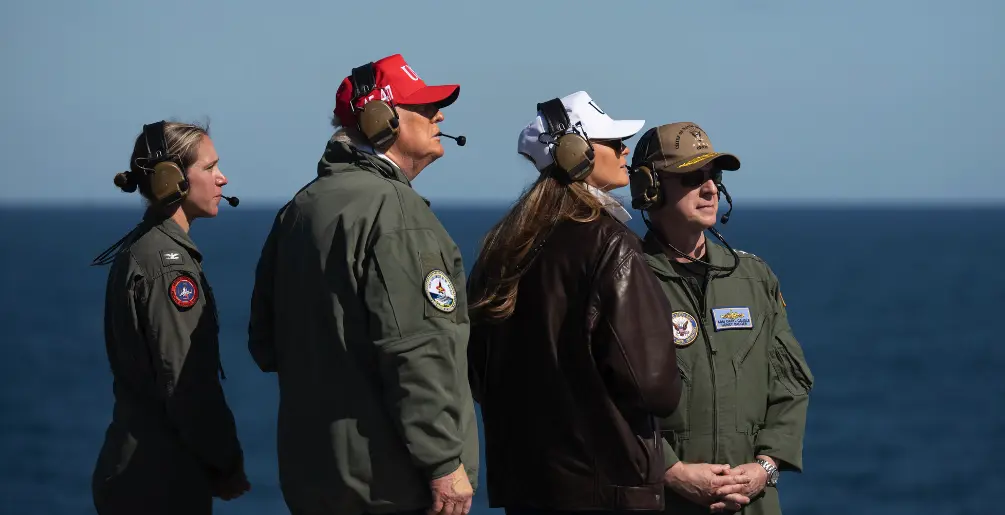
On June 22, 2025, the US intervened in the Iranian-Israeli war by bombing Iranian nuclear facilities. A few hours later, Trump, along with his Vice President JD Vance, his Secretary of Defense Pete Hegseth, and Marco Rubio, who served as both Secretary of State and National Security Advisor, appeared in public and claimed that the complete destruction of the Iranian nuclear program had eliminated its threat for years to come. Just eight months later, the US is threatening a new war – allegedly primarily to destroy the supposedly deactivated Iranian nuclear program a second time.
Depending on who is speaking to whom in the US, different arguments are used to justify the war: On February 17, US Vice President Vance himself went to the Fox News studio , the favorite channel of Trump and his core constituency. In connection with Iran, Vance spoke exclusively about the danger of a possible Iranian nuclear bomb and its consequences in the form of a nuclear arms race.
His boss, Trump, speaks about Iran far more frequently. Each time, he varies the reasons he gives for the war. On February 20, he spoke of ۳۲,۰۰۰ people allegedly killed by Iranian security forces during the protests of January 8 and 9. Perhaps it is a coincidence that this number is almost exactly ten times the number of names on the list of victims published by the Iranian government. Clearly, the horrific figure of almost 3,200 dead, admitted by the rulers in Tehran, hardly impresses anyone anymore—no wonder, so soon after a genocide with at least 70,000 dead in the same region of the world, carried out with the active support of the US and all other Western countries.
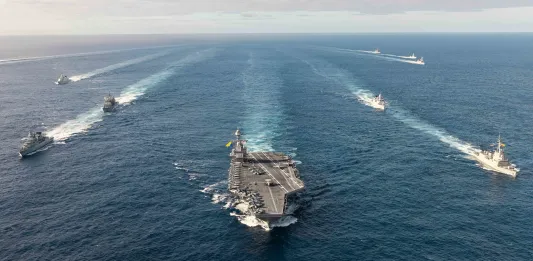
Military Built Up by US indicates an eminent threat of War!
Largest military concentration in West Asia since 2023
What makes a new war seem highly likely is the largest US military buildup in West Asia since 2003, when they prepared for the war in Iraq. The difference this time is that preparations are limited to a massive deployment of naval and air forces. Everyone rules out a US ground occupation of Iran. Even limited “special operations,” such as the clandestine operation carried out in early January 2026 to kidnap Venezuelan President Maduro and his wife, are rather improbable.
However, targeted killings from the air or the massive bombing of an entire city district to eliminate a single person are not unlikely – for example, following the model of the killing of the Lebanese His bollah leader Hassan Nasrallah by Israel in September 2024.
The US has now prepared for this and for air and missile attacks like those Israel carried out against seven countries, particularly after October 7, 2023. They have mobilized all available naval and air power. This includes a third of the entire US naval force and almost half of the American air force, which are now deployed in West Asia.
Among the weapons concentrated around Iran are some of the most modern in the world: The world’s largest aircraft carrier, named after the ill-fated former president Gerald Ford, passed through the Strait of Gibraltar on or before February 20th, returning from the operation against Venezuela. The last days of February will show whether the USS Gerald R. Ford remains in the eastern Mediterranean to protect Israel from Iranian retaliation, or continues through the Suez Canal and the Red Sea toward the northern Indian Ocean. Another US aircraft carrier, the Abraham Lincoln, has been stationed there for several weeks. Each aircraft carrier is the flagship of an entire fleet of smaller ships and submarines, whose duties include protecting the carrier.
Together with several US military bases in the countries surrounding Iran, the US can use the aircraft carriers as a base for launching hundreds of state-of-the-art fighter-bombers: F-35 stealth bombers can disable Iranian air defenses before the more numerous aircraft of other types, such as the F-15 and F-16, can attack unhindered. This opens up a range of possible operations: from renewed attacks on nuclear facilities and Iranian missile launch sites to the assassination of Iran’s Supreme Leader Ayatollah Ali Khamenei and other leading figures in the Islamic Republic.
Trump sets a deadline of 10 to 15 days.
On February 20, Trump gave Iran a deadline of 10 to 15 days to reach a “deal.” On February 19, he had spoken of only 10 days. Trump always combines such deadlines with the threat of military force—as he did on February 19 and 20.
No one seriously believes that negotiations as complex as those between the US and Iran can yield results in just a few weeks. The only possible reason for the deadlines mentioned by Trump is to make further military preparations.
There is no doubt that a renewed attack against a defenseless Iran would have already occurred. The sole reason for the lengthy preparations is the only military deterrents Iran possesses – missiles and drones. A large part of the US buildup is aimed at preventing Iranian retaliatory strikes. These could be directed not only against American military bases in the region, but also against Israel, oil terminals, and shipping through the Strait of Hormuz. This strait, dominated on its northern side by Iran, is the gateway from the Persian Gulf to the rest of the world. An estimated 25 percent of the world’s maritime oil trade and 20 percent of its gas trade pass through this narrow waterway.
Among others, the US think tank Atlantic Council warns of the potential consequences of military strikes against Iran, which would likely take the form of a weeks-long campaign and resemble a full-scale war compared to the operation in Venezuela. The Swiss private bank explains that oil flows could be significantly disrupted: “While the impact of geopolitical tensions on financial markets is often limited or only temporary, in this case, oil markets create a direct link to the global economy and wider supply chains,” writes Nannette Hechler-Fayd’herbe, Chief Investment Officer for Europe, the Middle East, and Africa, in a research note.
Even a temporary disruption to oil and gas transport through the Strait of Hormuz can cause energy prices to skyrocket worldwide. If gasoline prices rise in the US, voters there could take revenge on Trump’s Republican Party in the November 2026 congressional elections. Trump warned a few weeks ago that a Democratic-majority Congress might be tempted to initiate renewed impeachment proceedings to remove him from office. There is certainly enough domestic political justification for this.
Not only in the US, but also in other Western countries, there is concern about the dark clouds over West Asia. Verbal attacks by Trump and his circle against Great Britain confirm the accuracy of press reports that the London Starmer government has forbidden the US from using the British-American-controlled island of Diego Garcia in the Indian Ocean, as well as bases in Great Britain itself, for attacks against Iran.
Both sides want to demonstrate their strength.
The massive US buildup around Iran is taking place in full view of the world. This is intentional. Unlike in June 2025, the Islamic Republic will no longer be caught off guard by an attack in 2026. Without the element of surprise, however, psychological warfare remains. Its aim is to demoralize the enemy.
Western media outlets are full of scenarios about how a military strike against Iran could unfold: The Wall Street Journal, for example, reported that a short, sharp strike could be followed by Tehran demanding its surrender. If the Iranian leadership proves unwilling to comply, weeks of devastating bombing will ensue.
Given the military superiority of the US, these are not empty threats. Substantial threats are part of psychological warfare. However, in this discipline of warfare, Tehran’s inferiority is not as obvious as in actual, existing branches of the armed forces.
But Iran is also attempting to demonstrate its power: On February 18, long lines of merchant ships formed in the direction from the Indian Ocean to the Persian Gulf. Shortly before, the Iranian Islamic Revolutionary Guard Corps (IRGC) had blocked the Strait of Hormuz in one direction for several hours for a military exercise . This was the Islamic Republic’s response to the psychological warfare waged by the United States.
The Iranian leadership is also proving itself quite adept at psychological warfare in other respects. While the whole world is talking about the possible imminent assassination of Ali Khamenei , the 86-year-old Ayatollah appeared on February 19th in a hall of his residence almost always used for his appearances, to listen to Quran recitations marking the beginning of the holy month of Ramadan. This was just two days after a 40-minute speech he had delivered in the same hall.
Even if the supreme leader is otherwise residing in an underground bunker, he has not yet ceased his occasional public appearances at his usual location – this too sends a signal to both his supporters and his enemies: Iran is not outwardly displaying any nervousness. This attitude is evident in all statements from supporters of the Islamic Republic of Iran who participated in nationwide, state-organized rallies against the US on January 12 and February 11 .
The role of the right-wing exile opposition
The right-wing Iranian opposition in exile, including former Crown Prince Reza Pahlavi, does not shy away from describing the massacres of protesters in Iran as genocide . This clearly presupposes a significant lack of understanding of the term genocide among the target groups. However, the term “genocide” fits the discourse of the Iranian right-wing opposition.
According to this view, there was no revolution in Iran in 1979, but rather a foreign occupation. Forty-seven years later, the Pahlavi camp claims that the mass murder in Iran on January 8th and 9th was carried out by Afghan and Arab mercenaries of the Islamic Republic. This claim aligns with the pogrom-like atmosphere against people with a migration background in Iran, especially against those of Afghan origin who were either born in Iran or have lived there for decades.
Reza Pahlavi appears confident that a military strike against Iran is imminent. After expressing some disappointment in mid-February during his appearances in Munich on the sidelines of the security conference regarding the lack of a US military operation against Iran, he called on his supporters in the Iranian diaspora on February 20th to persevere in demanding war.
He added that exiled Iranians should refuse to vote for those Western politicians who are trying to prevent the war. This is clearly a reference to the US congressional elections, in which Iranian-Americans could be the deciding factor.
The main function of the right-wing Iranian diaspora at the moment is thus to be seen in propaganda for a war against Iran. Once again, the so-called humanitarian intervention is being invoked – primarily out of consideration for people in the West who favor the same approach to preventing Iran from acquiring nuclear weapons that led to the 2015 nuclear agreement – which has since been torpedoed by the US, the EU, and Great Britain .
Like the announced intention to once again destroy the nuclear program allegedly dismantled in June 2025, the argument – protecting the people of Iran from an overbearing regime – seems to be based on widespread amnesia among the target groups.
The intended audience of this propaganda should actually be aware of how other supposedly “humanitarian interventions” have played out. However, for many, Libya in 2011 is too far in the past to know that Western military intervention in that North African country was what ultimately caused the catastrophe. Libya has been plagued by chaos, slavery, and gang warfare for almost 15 years .
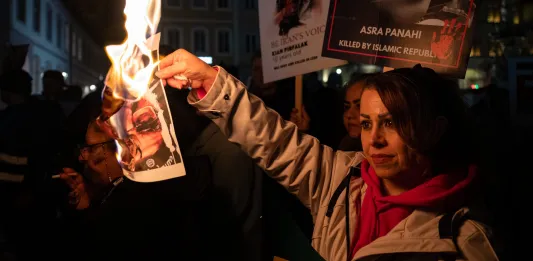
A woman protesting in Tehran
A traumatized people
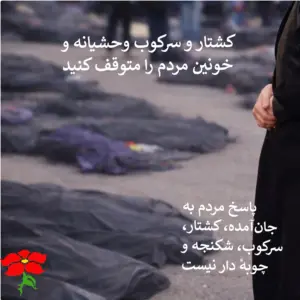
In Iran itself, almost the entire population is traumatized by the events of January 8th and 9th . Even those who believe the propaganda prevalent in Iran and who speak of an American-Israeli coup attempt in connection with the catastrophe in January are asking – sometimes quite publicly – what the civil war-like scenes of six weeks ago say about the security policy competence of those in power.
Most Iranians are already at least critical of the Islamic Republic. Many people in Iran are so consumed by rage against murderers that they defiantly shout slogans that, in their view, most infuriate the ruling class: and that is, in fact, the declaration of support for the Pahlavi family. Massacres of protesters have occurred repeatedly in Iran since 2019, if one doesn’t already use that term to describe the murderous suppression of the so-called Green Movement in 2009/2010 and the economically motivated unrest around the turn of the year 2017/2018.
With each brutal wave of repression, more hatred and anger festered among the people. Even the remarkable success of the Jin Jiyan Azadi movement in 2022-2023 in effectively ending the mandatory hijab did little to alleviate this pent-up anger. This anger is one possible explanation for the pro-Pahlavi rhetoric in Iran. After all, Pahlavi represents the most extreme rejection of the 1979 revolution. If there were a terrorist, openly Islamophobic organization that unashamedly confessed to murdering Muslims, it would likely find even greater support among those in Iran who now celebrate Pahlavi.
Fascist International
The fascization of tens of thousands of exiled Iranians, however, requires a different explanation. There is no question of these people being directly traumatized – unlike the population in Iran, they do not have to fear for their lives. The fact that the largest demonstration to date in Germany against the Islamic Republic was organized by monarchists in Munich on February 14th is primarily due to the fact that the Pahlavi family is at the head of the Iranian branch of a fascist international.
In Persian-language media, monarchists have been speaking of murder and manslaughter for years. The most prominent Iranian fascist is Yasamin Pahlavi, the wife of the former Crown Prince. Since the Jin Jian Azadi movement, almost three years ago, she has been wishing death upon three groups on social media : the “corrupt” trio of mullahs, leftists, and the People’s Mojahedin. For Pahlavi, these three forces joined forces in 1979 to overthrow the Shah.
Pahlavi’s message resonates strongly within the Iranian diaspora, partly due to the increasingly prevalent fascist sentiment in Western countries. When Pahlavi’s followers raise the Israeli flag worldwide, it serves as a signal of distancing themselves from other migrants, directed specifically at the countries where the Iranian diaspora resides. The message is essentially: Don’t treat us like other migrants from predominantly Muslim countries, because we are fully integrating into anti-Muslim societies.
“One country – one people – one leader”
While the Pahlavi discourse in Persian comes across as openly fascist – one of his prominent supporters even shouted the slogan ” One fatherland – one banner – one leader ” from the stands in Munich – the former Crown Prince himself presents himself as a respectable figure. It is therefore no wonder that the Bild newspaper raves about him.
On the sidelines of the Munich Security Conference, Pahlavi participated in a town hall-style event and a press conference. He agreed to all the rules and behaved himself. He very unregally complied with the request of the British-Iranian celebrity journalist Christiane Amanpour and, after speaking with her, simply took a seat in the audience.
He then had to listen to US Senator Lindsey Graham simply deny that he supported Pahlavi as the future leader of Iran, justifying himself by saying that endorsing a leader for Iran was not his job. Graham also failed to mention Pahlavi at all in his speech the following day at the Theresienwiese to tens of thousands of Pahlavi supporters. This is typical of a US congressman whose constituency is said to be not South Carolina, but Israel.
However much Pahlavi tried to cultivate his image as a tabloid hero, he couldn’t restrain himself in his response to a question from a BBC Persian representative at the press conference: The journalist had asked why Pahlavi hadn’t been able to forge a coalition within the Iranian opposition. In what was now familiar Trumpian fashion, Pahlavi rebuked and contradicted the BBC representative.
According to Pahlavi, his critics are limited to supporters of the Islamic Republic, the People’s Mojahedin, and so-called separatists—primarily Kurds. Apart from these groups, he claimed, the Iranian people are already united under his leadership. The former Crown Prince clearly relished this assertion, repeatedly dismissing claims of national disunity as blatant lies after the press conference.
Billions in support
The rise of Iranian monarchists to become the strongest force in the Iranian diaspora and a considerable movement within Iran would not have been possible without the media campaign for Pahlavi that has been ongoing for over ten years.
The team of Swedish-Iranian media scholar Mazdak Azar has discovered that the two most important Persian-language television stations broadcasting from Western countries reported on Pahlavi and monarchists five times and twice as often, respectively, as the original footage from the protests showed. Azar’s team compared thousands of video clips on social media with a comparable number of reports from Iran International and BBC Persian. The result could hardly be clearer: Iran International devoted 400 percent more coverage to the Pahlavi camp than its share of the protests in Iran warranted. In the case of BBC Persian, this bias was “only” 100 percent.
The media support from the West has accumulated to billions over the years. It’s difficult to estimate the production costs for a broadcaster that produces content around the clock. However, a conservative estimate puts the annual budget for a 24-hour broadcasting station at tens, if not more than one hundred million dollars. And there are more than a few Persian-language exile broadcasters. Some of these media outlets have been operating for 20 years.
It is therefore no exaggeration to speak of billions in support. The broadcasters are financed directly or indirectly by Western states – and Israel. In addition, there are millions of digital avatars on social media, which require thousands of powerful computers. The French newspaper Le Figaro therefore reported in early February on an AI-supported anti-Iranian campaign by Israel .
Bavarian police as friend and helper
Reza Pahlavi also received support from the Munich police: On February 14, he participated in a rally of his followers on Munich’s Theresienwiese. Behind the grandstand, a court reporter asked him what he had to say about the alleged 250,000 people on the Theresienwiese. Pahlavi was visibly surprised and said he had heard of about half that number.
He apparently knew nothing about his friend and helper, the Bavarian police. They had reported 250,000 people on the Theresienwiese. Three days later , the Süddeutsche Zeitung reported that the police had apparently “miscalculated” the number of people present on the Theresienwiese. According to research by the Süddeutsche Zeitung, including an analysis of video surveillance footage and interviews with experts, the demonstration area was between 55,000 and 65,000 square meters. Statisticians calculate an average of one and a half people per square meter at such demonstrations. The number of demonstrators in Munich must therefore have been definitely less than 100,000.
The German police, who systematically report that the number of people at left-wing demonstrations is smaller than the number estimated by the organizers, have clearly been very generous in their estimate in Munich.
Marginalization of Europe
The stance of the German police, along with that of the entire European political establishment, has become irrelevant in the Iran conflict. While the 2015 nuclear agreement was reached after negotiations between the Islamic Republic and the five permanent members of the UN Security Council plus Germany, the 2026 nuclear negotiations will take place solely between Iran and the USA.
Europeans have only themselves to blame for this marginalization: In August 2025, they referred the Iranian nuclear agreement back to the UN Security Council, effectively delivering a death blow to the 2015 nuclear deal. However, the agreement had already become practically irrelevant since Trump’s unilateral withdrawal from it in 2018 – during his first term in office.
The EU took a further step away from diplomacy with Iran at the end of January 2026 by classifying the Iranian armed forces, the IRGC, as a ” terrorist organization ,” two weeks after German Chancellor Friedrich Merz (CDU) had claimed, amid nationwide protests, that regime change in Iran was a matter of weeks or even days . Now, Agnes Strack-Zimmermann, a backbencher from the FDP in the European Parliament, has demanded that the EU expel Iranian diplomats . However, the EU is likely to shy away from this.
The signs currently point clearly to a US military attack. Whether further negotiations and an agreement will prevent this seems rather unlikely. However, at least parts of the Iranian leadership appear to be willing to make further concessions to the US.
“For an agreement to be lasting, it is crucial that the US also benefits in areas that generate high and rapid economic returns,” said Hamid Ghanbari, deputy director for economic diplomacy at the Foreign Ministry, according to the semi-official Fars news agency. Apparently, according to Ghanbari, the Islamic Republic is prepared to sell off Iranian natural resources if the West abandons its war path.